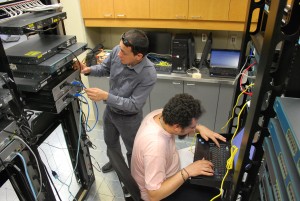
Back in 2013, we introduced a new AEC to our RAC services: Cisco Certified Network Associate (CCNA). Since its launch, our CCNA RAC offering has produced more than 90 graduates. CCNA was particularly noteworthy for having a weekend and week-night schedule, and a focus on hands-on exercises and labs. Today, we’re happy to announce that we’re working on another Cisco-related AEC, one step above our CCNA offering: Cisco Certified Networking Professional (CCNP). Many of our CCNA graduates expressed an interest in Champlain offering an AEC in CCNP, and we’re glad to be working towards it.
Our CCNP offering is currently in development, and is expected to launch in summer 2016. To be eligible, candidates will need to have a significant work or life experience in the field of networking, particularly where complex networks are concerned. They will need to have knowledge of routing, switching, security, and should be able to troubleshoot complex networking problems. Often, they would have previously worked as network administrators, network support technicians, or in similar roles.
CCNP candidates will not need to have any certifications from Cisco Systems to apply, nor will they need to have a Cisco CCNA AEC in hand. They will, however, need a substantial amount of experience in relevant positions, with a CCNP level of complexity. Part of the RAC admissions process involves an interview with a professional from the industry – this is where we will determine whether the experience is sufficient.
The total cost for the program will be $315, and most candidates should be able to complete it within 3-5 months. And, like CCNA, CCNP is expected to feature a flexible schedule, hands-on evaluations and labs.
When candidates complete the RAC process for CCNP, they will receive an AEC, an official, ministry-recognized certificate that can show employers that their competencies are up-to-date. It’s important to note that the RAC process, in and of itself, will not award the CCNP certification offered by Cisco Systems. However, the RAC process will likely play a useful role in helping candidates get more comfortable with the material that will ultimately be part of their certification exam at Cisco Systems.
Like our CCNA graduates, CCNP RAC graduates will have no obligation to pursue the proprietary certification from Cisco Systems. In the end, our AEC is meant to enhance a candidate’s prospects when approaching employers. It’s up to each particular candidate to decide whether they want both an AEC and a certification from Cisco Systems directly.
Our Cisco CCNP service is scheduled to launch in summer 2016. If the service seems like it may interest you, feel free to send us your CV for a personalized assessment. By signing up, you’re adding your name to the waiting list to be part of the pilot group. When the service is ready to launch, we’ll contact you for more information. In a few weeks, we’ll have a booth at the Salon de l’Intégration et de l’Insertion Professionnelle, in the “Education and Training” section. The Salon is designed to provide assistance to immigrants, students and citizens who are looking to:
Integrate successfully into Quebec and Canadian society;
Acquire Canadian work experience and/or training;
Get employed, or change their current job;
Expand their network of contacts;
Start a business.
We’ll be there to promote two branches of services at Champlain, both of which result in official recognition. For those with a significant amount of work experience, we’ll introduce the RAC process, which results in either an AEC or a DEC. For those with little to no work experience, we’ll suggest the AEC programs offered through Continuing Education. Regardless of the path taken, obtaining an AEC or a DEC can be helpful for those that are looking to integrate into the Quebec workforce.
The Salon de l’Intégration et de l’Insertion Professionnelle will be located at the Palais des congrès de Montréal, and will have the following schedule:
Thursday, February 11th, 2016 – 11am to 7:00pm.
Friday, February 12th 2016 – 10am to 6pm.
Admission is free.
We’re happy to announce that we recently signed a new memorandum of understanding with Concordia University. Thanks to this agreement, certain Champlain Continuing Education students will have the opportunity to request advanced standing towards related Concordia Continuing Education diplomas. Put simply, Champlain Continuing Education students may be exempt from certain Concordia Continuing Education courses, based on what they’ve completed at Champlain.
The following Champlain AECs and DECs are eligible with the listed Concordia diplomas:
We are proud to provide our students with a new way to advance their studies with Concordia, while potentially reducing the time it takes for them to do so.
For more information, please see the following PDF, or download the request form. Though we’ve been offering RAC services for many years, we recently felt it would be useful to highlight one specific aspect of said offering: our presence in Vaudreuil-Dorion. Officially, our RAC services are provided through Champlain College Saint-Lambert’s Continuing Education department. The college’s name specifically mentions “Saint-Lambert,” so it’s perfectly natural for some to conclude that the college solely exists in Saint-Lambert; however, this is not the case. Champlain College Saint-Lambert also has a service center in Vaudreuil-Dorion, a location that was strategically selected to support candidates that live or work in surrounding areas.
The Vaudreuil-Dorion service center can be useful for individuals looking to learn more about the RAC process. Rather than having to commute to Saint-Lambert, interested parties can choose to attend an info session in Vaudreuil-Dorion, or in Saint-Lambert – whichever makes the most sense for them. We feel this reflects the flexibility of the RAC process as a whole, beyond the immediate geographical benefits.
Furthermore, candidates pursuing an AEC in Early Childhood Education and Special Care Counselling may do so entirely through the Vaudreuil-Dorion service center. Those pursuing other RAC services, such as our AECs in Transportation and Logistics, Information Technology Client Support, Cisco (Cisco Certified Network Associate), and Applied Business Development, and our DECs in Office Management and IT Network Management can also take advantage of our Vaudreuil-Dorion location to complete their evaluations.
Champlain College Saint-Lambert, our primary location, is already well situated due to its proximity to Longueuil metro, which also features a bus terminal. Because of its proximity, those on the South Shore have numerous busses at their disposal for travelling between the Brossard and Longueuil terminals. Similarly, our Vaudreuil-Dorion service center simplifies the commute for those residing or working in the area, while also offering bus and train access through the AMT’s Vaudreuil station.
When both locations are considered, one truly gets a sense of how accessible RAC services really are. We hope this blog post will clear up potential misunderstandings, and provide both current and future candidates with a better glimpse at the flexibility offered by Champlain’s RAC services.
Current candidates that wish to take advantage of Champlain’s presence in Vaudreuil-Dorion should contact Carla Carpio at ccarpio@champlaincollege.qc.ca, or at 450-672-6046. Those that have yet to sign up for RAC may signal their service center preference via our regular sign-up form – the services differ per AEC/DEC, however, so additional inquiries may be required.
To find out more about RAC, feel free to attend our upcoming info session in Vaudreuil-Dorion: Wednesday, September 9th, at 6:30pm. To sign up, click here. Note: This article is also available in Spanish.
When the Recognition of Acquired Competencies (RAC) team at Champlain College Saint-Lambert was originally founded in 2009, it was quite modest in size: it comprised of one part-time employee, simply. Since then, we’ve grown to have 17 employees/professionals, with 65 content specialists when all services are factored in.
Through our work, we have the pleasure of meeting a multitude of talented individuals, from various fields, where each has their own story, goals, and challenges. What we do is simple: we tell them about a process, one which allows them to get recognition for the life and work experience they’ve accumulated thus far (towards a particular professional field). This is the RAC process, which, in our experience, most people are not aware of. It’s far more common, for example, for people to know about the traditional education model: buy books, attend class, and you’ll build up from knowing nothing about a topic to knowing it all by the end.
A RAC seminar in progress
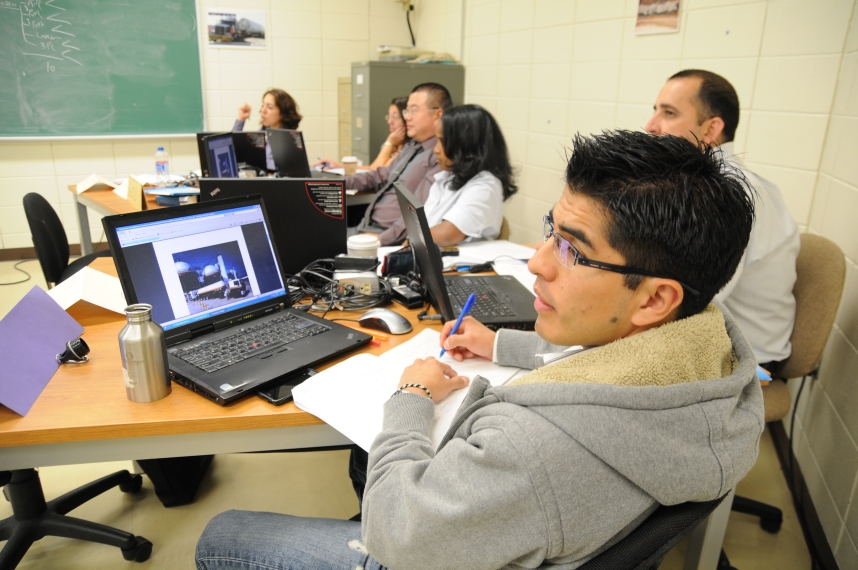
The traditional model is great for people that have little to no experience in a field; however, if an individual has a significant amount of experience, there’s another valuable option, RAC. Through the RAC process, a person can simply be evaluated for what they already know, and have the remaining bits filled by condensed, rigorous seminars and work sessions. At the end, regardless of the approach they take, they receive either an Attestation d’études collégiales (AEC), or a Diplôme d’études collégiales (DEC), depending on the service or program they selected. It should be noted that candidates don’t have to complete all competencies within the service or program if they don’t need to – they can just select those they desire (though they won’t receive an AEC or DEC).
As we hinted earlier, when we meet people at job fairs and beyond, they’re often surprised to find out that something like RAC exists. Yet, it’s so logical – if you have a significant amount of skill in a given area, and you can show us what you know – why can’t an educational institution treat that as progress towards a certificate or diploma? It’s an attractive prospect for most, provided they have enough experience to be eligible.
A RAC seminar in progress
At RAC, we determine eligibility early in the process: a candidate will meet an advisor, and if they seem like a good fit for RAC, they’ll be invited to what we call a validation interview. It’s in this interview that each candidate meets with an experienced professional from the industry, and they are asked questions to challenge their knowledge. By the end, there’s a clear list of what they’re ready to be evaluated for, what they need to review, or are missing altogether.
It’s important to mention: RAC candidate can have holes in their knowledge, as long as they have a significant amount of experience overall. We find many potential candidates tend to under-estimate themselves, yet, in our experience,people generally don’t realize how much they know. Some of our candidates were originally unsure of their knowledge, and yet, they were accepted, and succeeded. This is often because people tend to absorb additional knowledge and skills throughout the course of their professional careers, even if isn’t directly related to their primary role.
And for our candidates, their goals are generally about advancing their careers– RAC is a viable way to progress, in one way or another. While motivations vary from one individual to another, usually, our candidates approach RAC to either:
improve their employment prospects
get promoted
shift into a related field
In all of these scenarios, RAC services can be helpful: a certificate or diploma, at its core, shows to potential or existing employers that the candidate has relevant experience, validated by a Quebec college. While useful for all, this can prove especially useful for recently-arrived Canadians – it can serve as validation that they have up-to-date skills that are relevant in the Quebec job market.
An employment event where both active candidates and grads were in attendance.
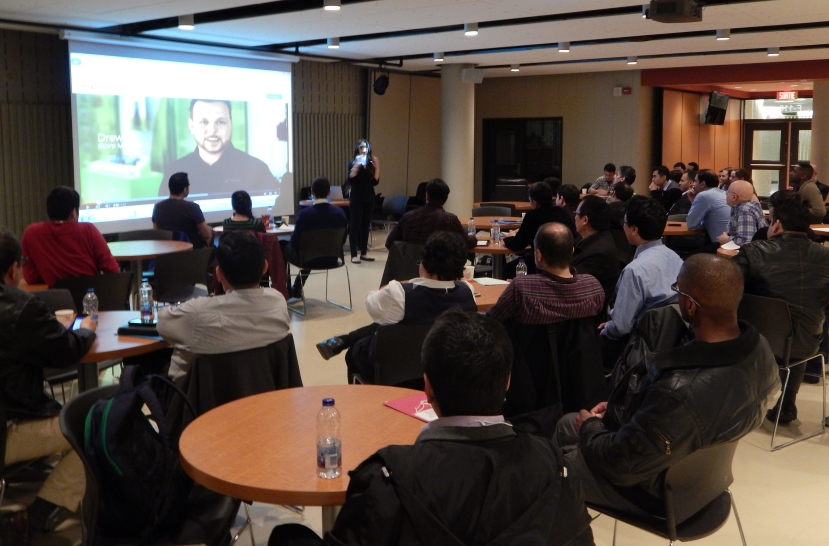
Beyond the direct benefits on CV, and in turn, in an interview, RAC candidates also benefit from a built-in, natural professional networking process. At RAC seminars, evaluations, and social events, they happen to meet and network with other talented professionals. And, even when our candidates graduate, they are not forgotten – they are often invited back for these employment events, where they have a chance to get a job, if they need it. When candidates participate in the RAC process at Champlain, they don’t just enter and exit – they join a collective that will look out for them even after they leave.
RAC candidates working on an activity in Champlain’s Vaudreuil-Dorion service center
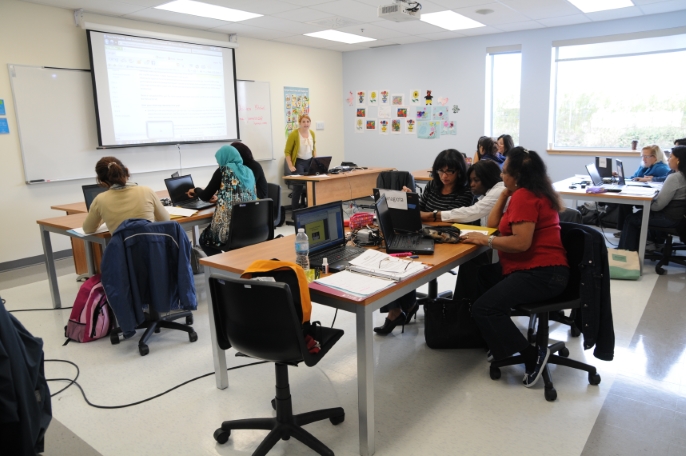
Flexibility is another element we like to highlight when describing Champlain’s RAC services. At the core of each service is a website which contains helpful online resources and seminar materials. There are no textbooks required with RAC at Champlain, which means candidates can review the content from home, at any given time. For seminars and evaluations, candidates generally need to visit either Champlain College Saint-Lambert, or its Vaudreuil-Dorion service center. As an example, Vaudreuil-Dorion offers seminars and evaluations for Early Childhood Education (ECE) and Special Care Counselling (SCC), and is also available as an alternate evaluation location for other services, if requested in advance. Candidates also have a choice, depending on the service, to either follow a weekend or weekday schedule – so even if they are working, they can still participate in RAC during the evenings, or on weekends. In some cases, we’ve even seen candidates stop RAC for months, leave to another country, return, and then resume right where they left off. Life sometimes has a way of complicating things, and we understand that at Champlain – our services are flexible enough to accommodate most of these cases.
Throughout the years, we’ve refined our services, and have had the pleasure of seeing many candidates achieve their goals: often, getting their first job in Quebec, or getting a promotion in their field. In 2013, our RAC expertise in this particular field was even recognized by the Quebec Government, as we were named one of four Centres of Expertise for the Recognition of Acquired Competencies (CERACs). Champlain’s CERAC supports college-level institutions in improving their RAC services.
Altogether, RAC services exist to help people get recognition for what they already know. To this end, Champlain College Saint-Lambert offers RAC services in multiple fields, including:
 CCNP candidates will not need to have any certifications from Cisco Systems to apply, nor will they need to have a Cisco CCNA AEC in hand. They will, however, need a substantial amount of experience in relevant positions, with a CCNP level of complexity. Part of the RAC admissions process involves an interview with a professional from the industry – this is where we will determine whether the experience is sufficient.
The total cost for the program will be $315, and most candidates should be able to complete it within 3-5 months. And, like CCNA, CCNP is expected to feature a flexible schedule, hands-on evaluations and labs.
When candidates complete the RAC process for CCNP, they will receive an AEC, an official, ministry-recognized certificate that can show employers that their competencies are up-to-date. It’s important to note that the RAC process, in and of itself, will not award the CCNP certification offered by Cisco Systems. However, the RAC process will likely play a useful role in helping candidates get more comfortable with the material that will ultimately be part of their certification exam at Cisco Systems.
CCNP candidates will not need to have any certifications from Cisco Systems to apply, nor will they need to have a Cisco CCNA AEC in hand. They will, however, need a substantial amount of experience in relevant positions, with a CCNP level of complexity. Part of the RAC admissions process involves an interview with a professional from the industry – this is where we will determine whether the experience is sufficient.
The total cost for the program will be $315, and most candidates should be able to complete it within 3-5 months. And, like CCNA, CCNP is expected to feature a flexible schedule, hands-on evaluations and labs.
When candidates complete the RAC process for CCNP, they will receive an AEC, an official, ministry-recognized certificate that can show employers that their competencies are up-to-date. It’s important to note that the RAC process, in and of itself, will not award the CCNP certification offered by Cisco Systems. However, the RAC process will likely play a useful role in helping candidates get more comfortable with the material that will ultimately be part of their certification exam at Cisco Systems.
 Like our CCNA graduates, CCNP RAC graduates will have no obligation to pursue the proprietary certification from Cisco Systems. In the end, our AEC is meant to enhance a candidate’s prospects when approaching employers. It’s up to each particular candidate to decide whether they want both an AEC and a certification from Cisco Systems directly.
Our Cisco CCNP service is scheduled to launch in summer 2016. If the service seems like it may interest you, feel free to send us your CV for a personalized assessment. By signing up, you’re adding your name to the waiting list to be part of the pilot group. When the service is ready to launch, we’ll contact you for more information. In a few weeks, we’ll have a booth at the Salon de l’Intégration et de l’Insertion Professionnelle, in the “Education and Training” section. The Salon is designed to provide assistance to immigrants, students and citizens who are looking to:
Like our CCNA graduates, CCNP RAC graduates will have no obligation to pursue the proprietary certification from Cisco Systems. In the end, our AEC is meant to enhance a candidate’s prospects when approaching employers. It’s up to each particular candidate to decide whether they want both an AEC and a certification from Cisco Systems directly.
Our Cisco CCNP service is scheduled to launch in summer 2016. If the service seems like it may interest you, feel free to send us your CV for a personalized assessment. By signing up, you’re adding your name to the waiting list to be part of the pilot group. When the service is ready to launch, we’ll contact you for more information. In a few weeks, we’ll have a booth at the Salon de l’Intégration et de l’Insertion Professionnelle, in the “Education and Training” section. The Salon is designed to provide assistance to immigrants, students and citizens who are looking to:
 We are proud to provide our students with a new way to advance their studies with Concordia, while potentially reducing the time it takes for them to do so.
For more information, please see the following PDF, or download the request form. Though we’ve been offering RAC services for many years, we recently felt it would be useful to highlight one specific aspect of said offering: our presence in Vaudreuil-Dorion. Officially, our RAC services are provided through Champlain College Saint-Lambert’s Continuing Education department. The college’s name specifically mentions “Saint-Lambert,” so it’s perfectly natural for some to conclude that the college solely exists in Saint-Lambert; however, this is not the case. Champlain College Saint-Lambert also has a service center in Vaudreuil-Dorion, a location that was strategically selected to support candidates that live or work in surrounding areas.
We are proud to provide our students with a new way to advance their studies with Concordia, while potentially reducing the time it takes for them to do so.
For more information, please see the following PDF, or download the request form. Though we’ve been offering RAC services for many years, we recently felt it would be useful to highlight one specific aspect of said offering: our presence in Vaudreuil-Dorion. Officially, our RAC services are provided through Champlain College Saint-Lambert’s Continuing Education department. The college’s name specifically mentions “Saint-Lambert,” so it’s perfectly natural for some to conclude that the college solely exists in Saint-Lambert; however, this is not the case. Champlain College Saint-Lambert also has a service center in Vaudreuil-Dorion, a location that was strategically selected to support candidates that live or work in surrounding areas.
 The Vaudreuil-Dorion service center can be useful for individuals looking to learn more about the RAC process. Rather than having to commute to Saint-Lambert, interested parties can choose to attend an info session in Vaudreuil-Dorion, or in Saint-Lambert – whichever makes the most sense for them. We feel this reflects the flexibility of the RAC process as a whole, beyond the immediate geographical benefits.
 Furthermore, candidates pursuing an AEC in Early Childhood Education and Special Care Counselling may do so entirely through the Vaudreuil-Dorion service center. Those pursuing other RAC services, such as our AECs in Transportation and Logistics, Information Technology Client Support, Cisco (Cisco Certified Network Associate), and Applied Business Development, and our DECs in Office Management and IT Network Management can also take advantage of our Vaudreuil-Dorion location to complete their evaluations.
Champlain College Saint-Lambert, our primary location, is already well situated due to its proximity to Longueuil metro, which also features a bus terminal. Because of its proximity, those on the South Shore have numerous busses at their disposal for travelling between the Brossard and Longueuil terminals. Similarly, our Vaudreuil-Dorion service center simplifies the commute for those residing or working in the area, while also offering bus and train access through the AMT’s Vaudreuil station.
When both locations are considered, one truly gets a sense of how accessible RAC services really are. We hope this blog post will clear up potential misunderstandings, and provide both current and future candidates with a better glimpse at the flexibility offered by Champlain’s RAC services.
Current candidates that wish to take advantage of Champlain’s presence in Vaudreuil-Dorion should contact Carla Carpio at ccarpio@champlaincollege.qc.ca, or at 450-672-6046. Those that have yet to sign up for RAC may signal their service center preference via our regular sign-up form – the services differ per AEC/DEC, however, so additional inquiries may be required.
To find out more about RAC, feel free to attend our upcoming info session in Vaudreuil-Dorion: Wednesday, September 9th, at 6:30pm. To sign up, click here. Note: This article is also available in Spanish.
When the Recognition of Acquired Competencies (RAC) team at Champlain College Saint-Lambert was originally founded in 2009, it was quite modest in size: it comprised of one part-time employee, simply. Since then, we’ve grown to have 17 employees/professionals, with 65 content specialists when all services are factored in.
Through our work, we have the pleasure of meeting a multitude of talented individuals, from various fields, where each has their own story, goals, and challenges. What we do is simple: we tell them about a process, one which allows them to get recognition for the life and work experience they’ve accumulated thus far (towards a particular professional field). This is the RAC process, which, in our experience, most people are not aware of. It’s far more common, for example, for people to know about the traditional education model: buy books, attend class, and you’ll build up from knowing nothing about a topic to knowing it all by the end.
Furthermore, candidates pursuing an AEC in Early Childhood Education and Special Care Counselling may do so entirely through the Vaudreuil-Dorion service center. Those pursuing other RAC services, such as our AECs in Transportation and Logistics, Information Technology Client Support, Cisco (Cisco Certified Network Associate), and Applied Business Development, and our DECs in Office Management and IT Network Management can also take advantage of our Vaudreuil-Dorion location to complete their evaluations.
Champlain College Saint-Lambert, our primary location, is already well situated due to its proximity to Longueuil metro, which also features a bus terminal. Because of its proximity, those on the South Shore have numerous busses at their disposal for travelling between the Brossard and Longueuil terminals. Similarly, our Vaudreuil-Dorion service center simplifies the commute for those residing or working in the area, while also offering bus and train access through the AMT’s Vaudreuil station.
When both locations are considered, one truly gets a sense of how accessible RAC services really are. We hope this blog post will clear up potential misunderstandings, and provide both current and future candidates with a better glimpse at the flexibility offered by Champlain’s RAC services.
Current candidates that wish to take advantage of Champlain’s presence in Vaudreuil-Dorion should contact Carla Carpio at ccarpio@champlaincollege.qc.ca, or at 450-672-6046. Those that have yet to sign up for RAC may signal their service center preference via our regular sign-up form – the services differ per AEC/DEC, however, so additional inquiries may be required.
To find out more about RAC, feel free to attend our upcoming info session in Vaudreuil-Dorion: Wednesday, September 9th, at 6:30pm. To sign up, click here. Note: This article is also available in Spanish.
When the Recognition of Acquired Competencies (RAC) team at Champlain College Saint-Lambert was originally founded in 2009, it was quite modest in size: it comprised of one part-time employee, simply. Since then, we’ve grown to have 17 employees/professionals, with 65 content specialists when all services are factored in.
Through our work, we have the pleasure of meeting a multitude of talented individuals, from various fields, where each has their own story, goals, and challenges. What we do is simple: we tell them about a process, one which allows them to get recognition for the life and work experience they’ve accumulated thus far (towards a particular professional field). This is the RAC process, which, in our experience, most people are not aware of. It’s far more common, for example, for people to know about the traditional education model: buy books, attend class, and you’ll build up from knowing nothing about a topic to knowing it all by the end.


You must be logged in to post a comment.